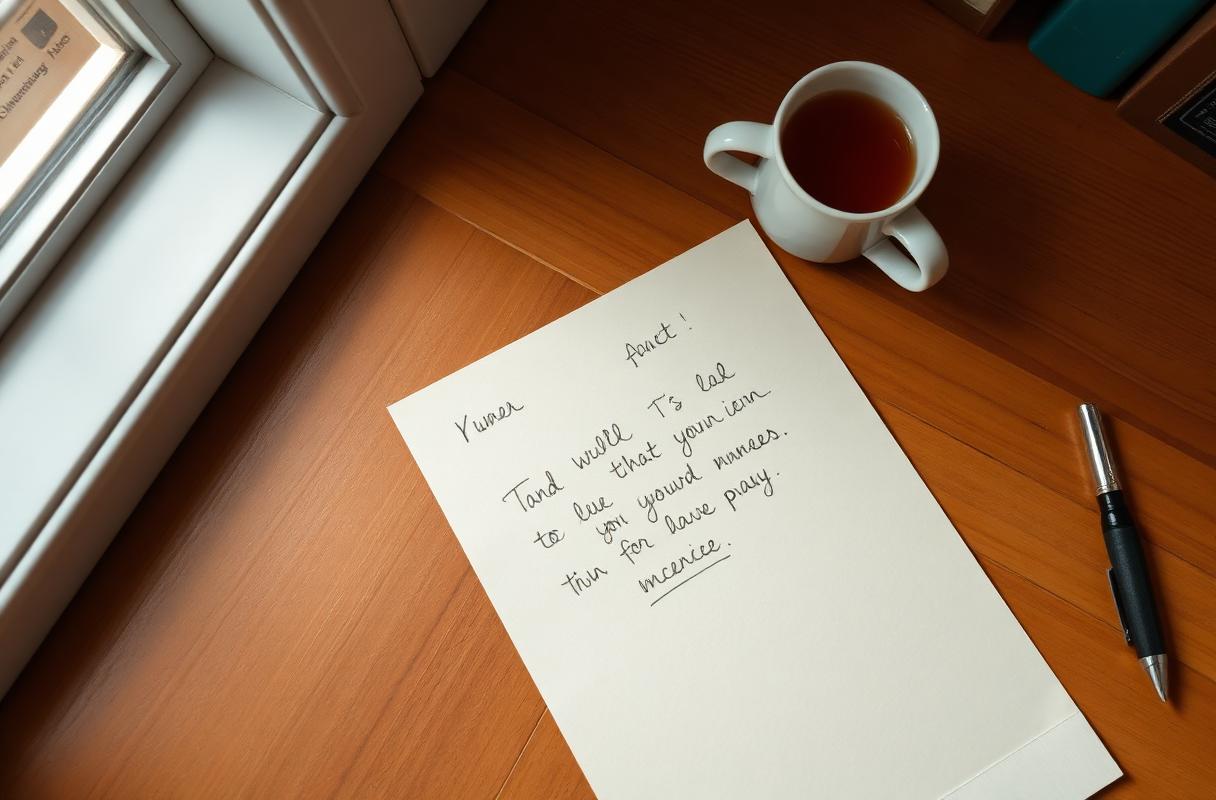
A letter of wishes and a Y.O.D.O. message are easy to confuse. Both are personal. Both are for the people you love. Both sit alongside the more formal documents you may already have, like a will. They are not the same thing, and they are at their strongest together.
This is a short, honest comparison.
What a letter of wishes is
A letter of wishes is an informal written document that sits alongside your will. It is not legally binding. Its job is to explain the human detail your will cannot carry: why you made certain decisions, how you would like particular belongings handled, who should look after a pet, what you want said at a funeral, and the things you would like the people you trust to know.
In the UK, a letter of wishes is usually:
- Written once, then revised every few years.
- Held by your solicitor, or kept with your will.
- Read by your executors after you die, alongside the will.
- Treated as a strong guide by the people who knew you, not as a legal instruction.
If you do not have one yet, our letter of wishes template walks through what to include.
What a Y.O.D.O. message is
A Y.O.D.O. message is a sealed, personal communication you write for one named person (a Recipient), or a small named group. It can be text, voice, video, or a file. It stays encrypted and sealed during your lifetime. It is released only after your passing has been formally verified by Y.O.D.O., with identity checks and a 72-hour dispute window.
A Y.O.D.O. message is usually:
- Short and specific. One person, one moment.
- Held privately by Y.O.D.O., not by your solicitor.
- Delivered directly to the named Recipient.
- Personal, not legal. It does not change who inherits what.
Where they overlap, and where they do not
Both are about being heard after you have gone. Both are about taking time now so the people you love do not have to guess later.
The difference is who reads them, and when.
- A letter of wishes is read by your executors and, often, the wider family. It is one document for the whole circle.
- A Y.O.D.O. message is read by the specific person you wrote it for. It is many small documents, each addressed and timed.
A letter of wishes is the right place to say "I would like my collection of records to stay together, ideally with my niece." A Y.O.D.O. message is the right place to say to your niece, in your own voice, what those records meant to you.
Side by side
| Letter of Wishes | Y.O.D.O. Message | |
|---|---|---|
| Format | Written text | Text, voice, video, or file |
| Audience | Your executors and circle | One named Recipient |
| Legal weight | None, but influential | None, personal communication |
| Where it lives | With your will or solicitor | Encrypted, held by Y.O.D.O. |
| When it is read | After your death, by executors | After verified passing, by the Recipient |
| Updates | Rewrite or amend on paper | Update or replace any time in the app |
| Cost | Free, or your solicitor's fee | Included in your Y.O.D.O. subscription |
Do you need both?
Most people will. They answer different questions.
- A letter of wishes answers: what would you like to happen, and why.
- A Y.O.D.O. message answers: what would you like this specific person to hear from you.
If you only have time for one this month, write the letter of wishes. It covers the most ground for the least effort, and it sits beside the document your executors are already going to read.
If you want the personal handover the letter cannot carry, start a Y.O.D.O. free trial and write the first message to the person who would most need it. No card required.